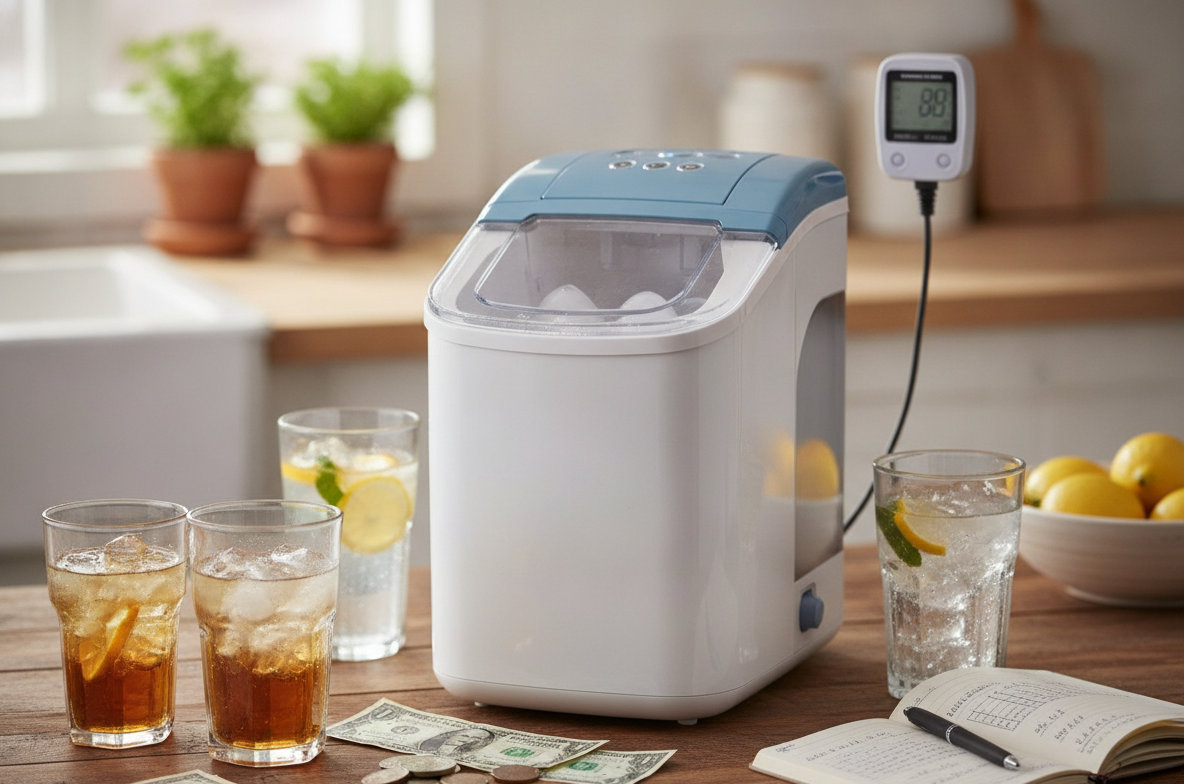
Most portable ice makers consume between 100 to 200 watts of power and can cost as little as $0.15 to $0.40 per day to operate, depending on usage and local electricity rates. This daily expense covers the energy needed to chill water, run the compressor, and cycle the water pump. Understanding these operational costs provides a clearer picture of ownership for apartment dwellers, RV owners, and anyone seeking convenient ice production.
Understanding Portable Ice Maker Energy Consumption
The primary factor in the daily cost of running a portable ice maker is its electricity consumption. These appliances are generally designed for efficiency, but their power draw varies by model and how frequently they operate.
Wattage and Kilowatt-Hours (kWh)
Portable ice makers typically have a wattage rating between 100W and 200W. This figure represents the power the unit draws when actively making ice. To calculate daily cost, you need to convert watts to kilowatt-hours (kWh). One kilowatt-hour is 1,000 watts used for one hour.
For example, a 150-watt ice maker running for 8 hours a day uses:
- 150 watts * 8 hours = 1200 watt-hours
- 1200 watt-hours / 1000 = 1.2 kWh
The average residential electricity rate in the United States fluctuates but often falls between $0.13 and $0.20 per kWh. Using an average of $0.15 per kWh, that 1.2 kWh translates to:
- 1.2 kWh * $0.15/kWh = $0.18 per day
If your ice maker runs for longer, say 12 hours, the cost increases. A 150-watt unit running for 12 hours would use 1.8 kWh, costing approximately $0.27 per day at the same rate. Higher wattage models, like those closer to 200W, will naturally incur slightly higher costs for the same run time.
Operational Cycles and Standby Power
Portable ice makers do not run constantly at peak wattage. They cycle on and off as needed to maintain ice production or keep the ice frozen in their insulated bins. The compressor and fan are the main energy consumers. The water pump also uses electricity during its cycles.
Many units have a standby mode where they draw a very small amount of power, typically less than 5 watts. This minimal draw accounts for the control panel and sensors. For most daily usage calculations, the active ice-making time is the most significant factor.
Water Consumption and Cost
While electricity is the primary cost, portable ice makers also use water. The cost of water is generally very low and often overlooked.
How Much Water Do They Use?
A typical portable ice maker producing 26 to 36 pounds of ice per day might use anywhere from 0.5 to 1 gallon of water to produce a full batch of ice (usually 10-12 pounds). The exact amount depends on the model and how much water is evaporated during the ice-making process.
Let's assume a unit uses 0.75 gallons for every 10 pounds of ice. If you make 20 pounds of ice per day, that's 1.5 gallons of water.
Calculating Water Cost
Residential water rates vary widely by municipality. A common rate might be $2.00 to $5.00 per 1,000 gallons. At $3.00 per 1,000 gallons, 1.5 gallons of water would cost:
- 1.5 gallons / 1000 gallons = 0.0015 units of 1000 gallons
- 0.0015 * $3.00 = $0.0045
This is less than half a cent per day. Clearly, water costs are negligible compared to electricity costs for most portable ice makers. However, using filtered water can extend the life of your machine by preventing mineral buildup, which is a good practice.
Maintenance and Cleaning Costs
Regular maintenance helps your portable ice maker run efficiently and last longer. This involves cleaning and, in some cases, descaling.
Cleaning Solutions
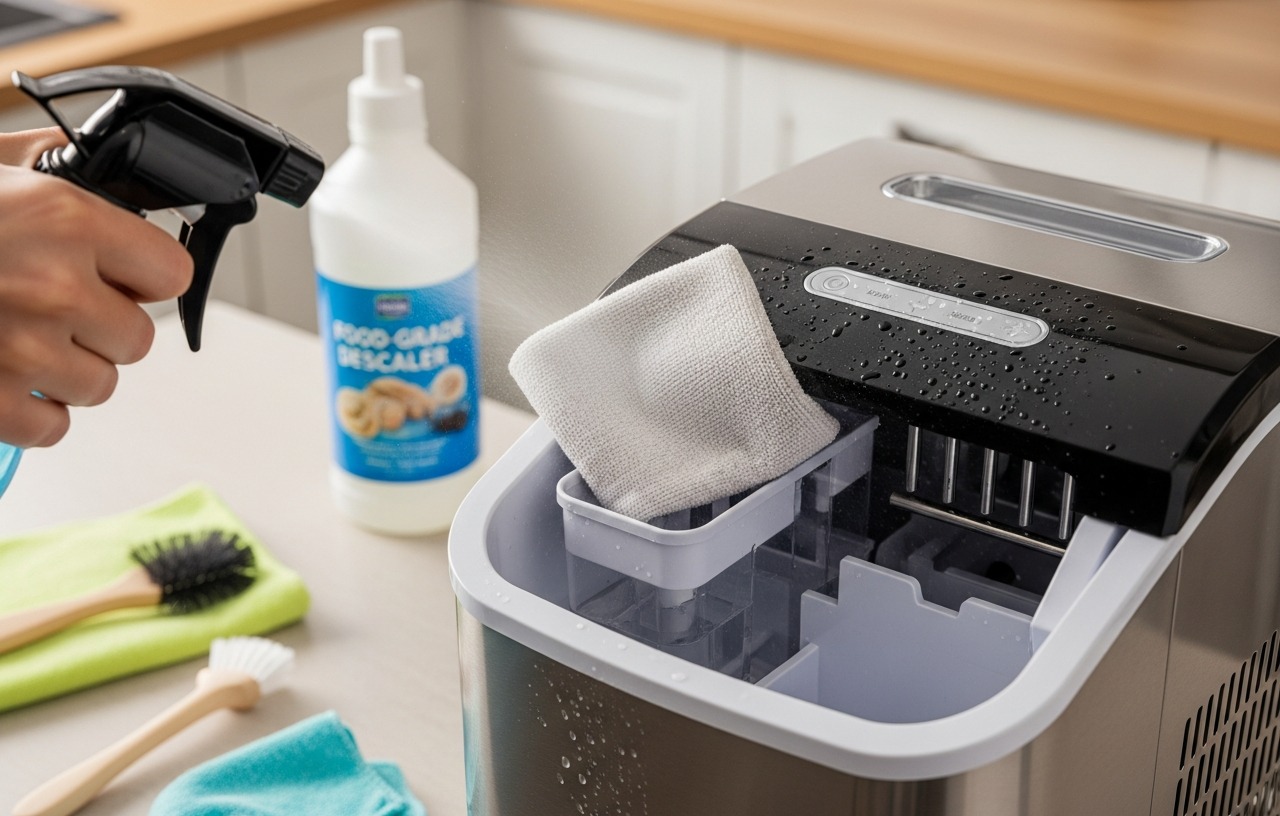
Manufacturers recommend cleaning your ice maker every 1 to 3 months, depending on usage and water hardness. You can use a solution of white vinegar and water, which is very inexpensive. A gallon of white vinegar costs around $3-$5 and can be used for many cleaning cycles.
Alternatively, commercial ice maker cleaning solutions are available for $10 to $20 per bottle. These bottles typically provide multiple cleanings. If a bottle costs $15 and provides 5 cleanings, that's $3 per cleaning. If you clean every two months, the monthly cost averages $1.50. This is a small but important part of long term ownership costs.
You can find detailed steps on cleaning your machine here: How to Clean a Countertop Ice Maker (step by step)
Filters (Rare for Portable Units)
Most portable countertop ice makers do not use replaceable water filters. They rely on the water quality you supply. If you use tap water, mineral buildup can occur, making regular descaling important. Some larger, plumbed ice makers do use filters, but this is not common for the portable category.
Potential Repair Costs: When DIY Makes Sense
Even with careful use, components can fail. A common issue with portable ice makers is a malfunctioning water pump. This prevents water from cycling over the freezing evaporator, meaning no ice is produced.
Scenario: Water Pump Failure
The water pump is a small, submersible pump responsible for circulating water from the reservoir to the ice-making tray. When it fails, you might hear the unit running, but no water moves, and no ice forms. Based on researched user reviews, this is a frequent point of failure.
DIY Repair Cost
If you are comfortable with basic tools and following online guides, replacing a water pump can be a DIY project. A new water pump for a portable ice maker typically costs between $20 and $50 when ordered online from parts suppliers or marketplaces. You might need a screwdriver set, which costs $15-$30 if you do not already own one. The repair itself usually takes 1 to 2 hours.
The financial benefit of DIY is clear here. For a total outlay of $20-$50 for the part (assuming you have basic tools), you can fix the machine. This is a significant saving compared to professional repair.
When considering a DIY repair, assess your comfort level with disassembling electronics. Make sure to unplug the unit and drain all water before starting. If the repair seems too complex, or if you fear damaging other components, professional help is an option.
Professional Repair Cost
Hiring a technician for a portable ice maker repair is often more expensive than the unit's original purchase price. Service calls alone can range from $75 to $150 per hour, with many companies having a minimum service fee of $100 to $200. The technician will also charge for the part, often with a markup.
For a water pump replacement, a professional repair might look like this:
- Service call/minimum labor: $100-$150
- Part cost (with markup): $40-$80
- Total estimated professional repair: $140-$230
Many portable ice makers cost between $100 and $250 new. A professional repair bill of $150-$300 or more often makes replacement the more economical choice, especially if the unit is several years old. This is a common dilemma with compact appliances. If your ice maker is not making ice, you can refer to troubleshooting guides before considering repairs. Countertop Ice Maker Not Making Ice? 7 Fixes That Actually Work
When to DIY vs. Replace
DIY repair makes financial sense when:
- The part is inexpensive ($50 or less).
- The repair is relatively simple (e.g., swapping a pump, cleaning a sensor).
- You have basic tools and confidence in your ability.
- The machine is still relatively new and otherwise functions well.
Replacement is often the better option when:
- The repair cost (even DIY for a more expensive part) approaches or exceeds 50% of a new unit's price.
- Multiple components are failing.
- The machine is old, and other parts might fail soon.
- You lack the time or confidence for DIY repair.
Total Daily and Monthly Costs
Let's summarize the typical daily and monthly operational costs for a portable ice maker, assuming moderate to heavy use (8-12 hours per day).
Daily Operational Cost
- Electricity: $0.15 - $0.40
- Water: Less than $0.01
- Total Daily Operational Cost: Approximately $0.16 - $0.41
Monthly Operational Cost (30 days)
- Electricity: $4.50 - $12.00
- Water: Less than $0.30
- Maintenance (cleaning solution, averaged): $1.00 - $2.00
- Total Monthly Operational Cost: Approximately $5.50 - $14.30
These figures do not include the initial purchase price of the unit or infrequent repair costs. They represent the ongoing expense to keep your portable ice maker running and producing ice.
Maximizing Efficiency to Lower Costs
Turn It Off When Not Needed
Portable ice makers are not designed to store ice for extended periods like a freezer. Their insulated bins only keep ice frozen for a short time before it begins to melt, returning water to the reservoir. Running the machine continuously to maintain a small amount of ice is less efficient than making a batch, using it, and then turning the machine off.
Use Cold Water
Starting with cold, filtered water reduces the compressor's workload. The machine does not need to expend as much energy to bring the water down to freezing temperature. This can marginally reduce energy consumption per batch.
Regular Cleaning
Mineral buildup (limescale) from tap water can coat the evaporator coils and water pump, reducing their efficiency. A machine struggling with limescale uses more energy to produce the same amount of ice. Regular cleaning ensures all components operate optimally, maintaining energy efficiency.
Proper Placement
Place your ice maker in a cool, well-ventilated area. If the surrounding air is hot, the compressor works harder, increasing energy consumption. Keep it away from direct sunlight or heat-generating appliances.
Running a portable ice maker daily is an affordable convenience. The electricity costs are modest, and water usage is minimal. With proper maintenance and mindful use, these appliances provide a cost effective way to have fresh ice on demand without a built-in ice maker.